The APANI Way
High end audio is at its best when it stops sounding like hi-fi and starts sounding like truth. Remove impurities, level mismatch, reflections, asymmetry, timing errors and noise, until only the music remains: as pure as nature intended.
What this standard covers
The AAES Standard is organised in twelve parts.
- Goal of the evaluation: better instead of just different
- Preparation: tools, rules, safety net
- Setup in sixty minutes: fair evaluation, not the room problem
- How to listen correctly: a reproducible session workflow
- Evaluation sheet: the twelve axes that really matter
- Listening guide per axis: correct sound, errors, and fix
- Bonus criterion: timing, pace, rhythm and groove
- Listening tracks: references with cue times and target sound
- ABX protocol: properly testing audibility
- If, then: a quick checklist from issue to action
- Decision: keep it or not
- Worksheets: printable log sheets
The three questions every evaluation must answer
Is the difference truly audible, or only expectation?
Is it musically better for your music, your volume, your room?
Is it sustainably better after a week of ordinary listening, once the novelty has worn off?
You are never evaluating a loudspeaker alone. You are always evaluating the complete system: loudspeaker, room, placement, level, and optional subwoofer.
Minimal tools, simple but effective
A tape measure or laser, plus painter's tape, to mark positions.
A mirror, to find first reflection points.
Two to four blankets or towels, as temporary absorbers.
A smartphone with an SPL app, plus pink noise or a test signal, for level matching.
A notebook or evaluation sheet. Otherwise your memory will fool you.
Hearing safety and listening quality
For longer sessions, listen at 65 to 75 decibels LAeq as a comfort and fatigue level: pleasant, safe, and suitable for hours of work.
Judge tonal balance, however, at a fixed reference level around 85 decibels. At lower levels, your ear deceives you about bass and treble.
Avoid long sessions above 80 to 85 decibels LAeq. Listening fatigue distorts judgment and makes everything sound sharper and flatter.
Two levels, two purposes. Listening quietly protects the ear and concentration. At the reference level, the true tonal colour appears. Never confuse one purpose for the other.
Setup in sixty minutes
If placement is unstable, the evaluation becomes random. These steps quickly create a stable baseline.
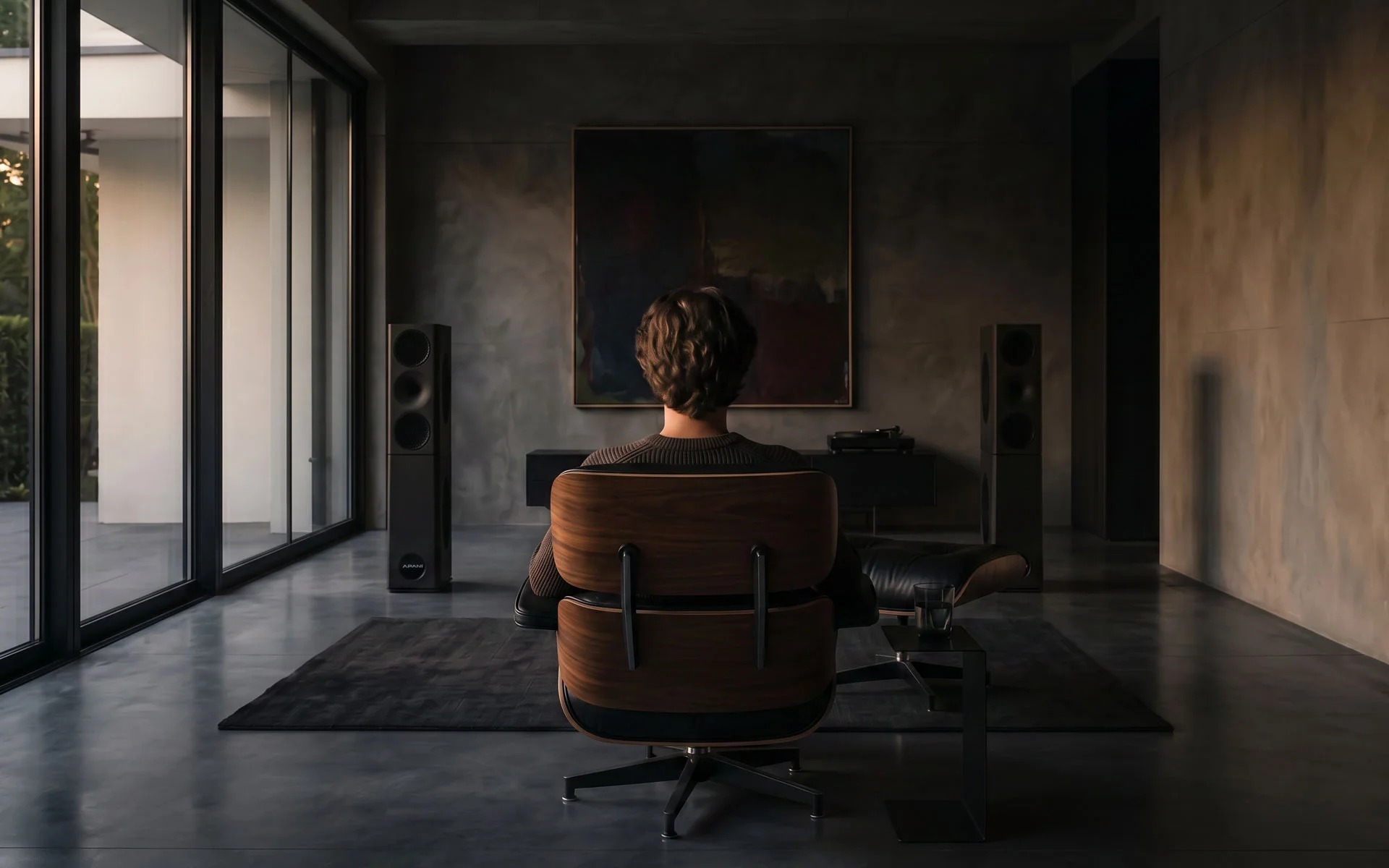
- Geometry, ten to fifteen minutes. Listening seat centered, loudspeakers left and right symmetrical. Equilateral triangle: speaker to speaker distance approximately equals speaker to listener distance. Tweeter at ear height. Left and right speaker to seat distance as identical as possible, within five millimetres.
What you hear when it is right: a clean phantom centre locks in. Vocals do not drift, and left and right do not sound different. Symmetry is purity. When geometry is right, the loudspeaker stops pulling attention and the performance becomes stable, like real life.
- Toe in, five to ten minutes. Starting point: the loudspeaker axes cross just behind your head, then fine tune. Too much toe in and the stage often becomes narrower, the centre feels very direct or hard. Too little toe in and the stage often becomes flatter, focus softens, more room influence mixes in. The goal is width and precision at the same time, voice firmly centred, stage open, no sharpness.
Toe in is not a trick. It is a purity tool. It balances direct truth against room influence until the sound becomes natural and effortless.
- First reflections, ten to fifteen minutes. Mirror method: sit in the listening position while a second person moves a mirror along the side wall. Wherever you see the loudspeaker in the mirror, there is a first reflection point. Immediate measure: a blanket, curtain, carpet or absorber at these points.
Sourced and dated
Source and terminology basis: Definition of Terms, Audiophile Complete Book v4.2, 29 October 2025 (track selection, level and ABX principles, vocabulary). This edition created 11 January 2026, integrated update 18 June 2026.